In Saskatoon, the grain size distribution of glacial tills and alluvial silts along the South Saskatchewan River dictates everything from frost heave potential to foundation bearing capacity. A routine visual classification rarely captures the full story—particularly when fines content hovers near the 15 to 20 percent threshold that separates free-draining from moisture-sensitive behavior. The combined sieve and hydrometer analysis resolves this ambiguity, providing a complete particle-size curve from coarse gravel down to the clay fraction. Whether the project involves a deep excavation in the Lake Agassiz lacustrine clays of the city's eastern margins or a shallow footing on the Sutherland Group tills, the grain size analysis anchors the geotechnical model. We also integrate the results with Atterberg limits to confirm the plasticity characteristics of the fine fraction, an essential cross-check when evaluating the expansive potential of local overburden soils.
A well-defined particle-size curve is the first line of defense against frost heave in Saskatchewan's silty tills—without it, subgrade performance becomes a gamble.
Technical details of the service in Saskatoon
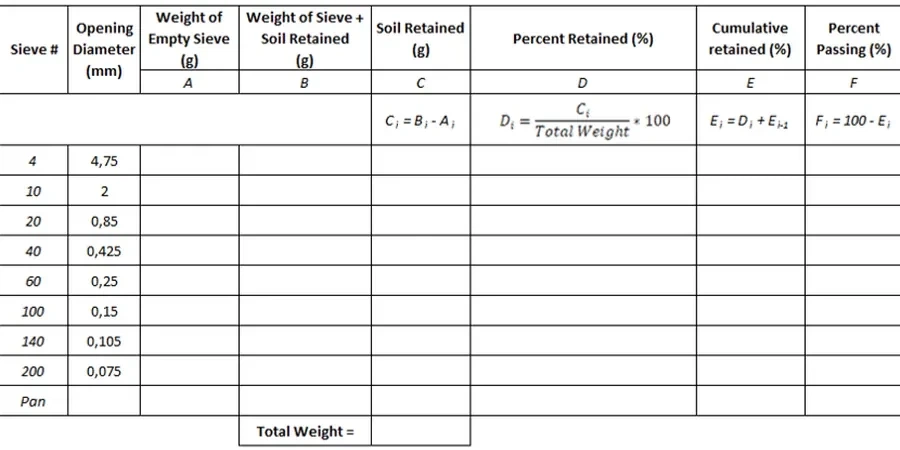
Typical technical challenges in Saskatoon
The glacial stratigraphy beneath Saskatoon is notoriously variable—fluvial sand lenses sit directly beneath stiff till, and pockets of soft lacustrine silt appear where ancient proglacial lakes once ponded. A grain size analysis that ignores the hydrometer fraction can misclassify a silty sand as a clean sand, leading to overestimated permeability and underestimated frost susceptibility. In 2012, a commercial building in the city's Stonebridge neighborhood experienced differential heave because imported fill was accepted based solely on sieve data; the 12 percent fines content, only detectable through sedimentation analysis, proved sufficient to trap moisture and generate ice lenses during a prolonged cold snap. Our laboratory runs the full hydrometer procedure with temperature-corrected readings over 24 hours, plotting the complete particle-size distribution so that the design team can identify gap-graded materials and assess internal stability. For projects near the river where groundwater fluctuations are seasonal and pronounced, this level of detail is not optional—it is what keeps retaining structures and pavement sections intact through the spring thaw.
Our services
The grain size analysis forms part of a broader suite of index and performance tests that our Saskatoon laboratory offers under an ISO 17025-accredited quality management system. Each service below addresses a specific stage of site characterization or construction verification.
Combined Sieve and Hydrometer Test
Full particle-size distribution from coarse gravel to clay fraction. Includes wash sieve procedure to accurately determine fines content and a 24-hour hydrometer sedimentation series with temperature correction.
Hydrometer Analysis Only (Fine Fraction)
Sedimentation analysis for samples already processed through the No. 200 sieve. Suitable for lacustrine clays and silty tills where the sand and gravel fractions have been characterized separately.
Wash Sieve and Fines Content Determination
Quantitative determination of percent passing the 75 µm sieve through wet washing, critical for verifying compliance with City of Saskatoon backfill and bedding gradation specifications.
Top questions
What does a grain size analysis cost for a project in Saskatoon?
A combined sieve and hydrometer analysis typically ranges from CA$150 to CA$260 per sample, depending on the number of sieves required and whether the sample needs preliminary processing such as oven drying or disaggregation. Projects with multiple samples often qualify for volume-based pricing; we recommend discussing the scope with our technical team to receive a tailored quote.
How long does the full hydrometer procedure take in the lab?
The hydrometer sedimentation phase requires a minimum of 24 hours to capture readings at the standard time intervals specified in CSA + ASTM D422. Including sample preparation, sieve analysis of the coarse fraction, and final data reduction, a complete combined test is typically reported within three to four working days.
Why is the hydrometer fraction important for Saskatoon's glacial soils?
Saskatoon sits on a complex sequence of tills, fluvial sands, and proglacial lake silts where the fines content can change dramatically over short distances. The hydrometer analysis quantifies the silt and clay fractions that control frost susceptibility, drainage behavior, and compressibility. Without it, a soil that appears to be a clean sand in the field may actually contain enough fines to be frost-active, a critical distinction under the city's winter conditions.
Which ASTM standard applies to grain size analysis for road aggregate in Saskatchewan?
Sieve analysis of coarse and fine aggregates for road construction follows ASTM D6913-04e1, while the complete particle-size distribution including the hydrometer fraction is covered by CSA + ASTM D422. The City of Saskatoon Standard Specifications further reference these methods and define specific gradation envelopes for base course, sub-base, and bedding materials.