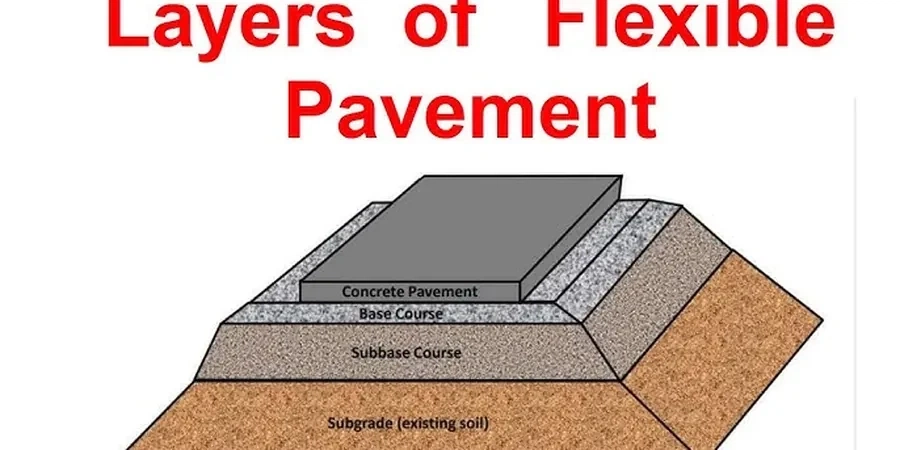
In Saskatoon, we often see pavement distress that traces back to one overlooked detail: the subgrade. The city sits on glacial Lake Agassiz deposits, a mix of clay-rich tills and silts that behave unpredictably under freeze-thaw cycles. A standard flexible pavement design here cannot rely on textbook CBR values. Our team runs site-specific CBR road tests to establish the soaked bearing capacity, because the difference between 3% and 6% CBR determines whether you need 150mm or 250mm of granular base. With over 260,000 people in the metropolitan area and a road network that endures -35°C winters, the structural section must resist both thermal cracking and spring thaw weakening. We combine laboratory Proctor tests with field density verification to ensure compaction meets the City of Saskatoon's 98% modified Proctor standard.
In Saskatoon, the difference between a 20-year pavement and one that fails in 5 years is usually the subgrade — not the asphalt.
Technical details of the service in Saskatoon
Typical technical challenges in Saskatoon
The risk that keeps pavement engineers awake in Saskatoon is differential frost heave. When the subgrade contains lenses of silt within a clay matrix, water migrates toward the freezing front and forms ice lenses that can lift the pavement by 50mm to 100mm unevenly. Come spring, the thawed soil loses all bearing capacity, and heavy truck traffic pounds the weakened structure into a pothole-riddled surface. Another threat is the high plasticity of the local glacial till — liquid limits above 50% mean the soil swells when wet and shrinks when dry, cracking the asphalt from below. Our mitigation strategy includes specifying a non-frost-susceptible subbase at least 300mm deeper than the frost line, and in severe cases we recommend in-situ permeability testing to assess drainage. Without positive drainage, even the best pavement section will pump fines and deteriorate within a few seasons.
Our services
Our flexible pavement design consultancy in Saskatoon covers the full cycle from subgrade investigation to structural thickness calculation, always adapted to the local glacial geology and climatic loading conditions.
Subgrade bearing capacity evaluation
Field CBR tests and laboratory soaked CBR on Shelby tube samples, correlated with resilient modulus for AASHTO structural design.
Granular base and asphalt mix design
Marshall method design with local aggregate sources, including gradation, binder content, and stability/flow verification.
Frost protection and drainage analysis
Calculation of frost penetration depth, assessment of subgrade frost susceptibility, and design of capillary break and drainage layers.
Top questions
How much does a flexible pavement design study cost in Saskatoon?
The fee for a pavement design package, including subgrade investigation, laboratory CBR/Proctor, and the structural thickness calculation, ranges from CA$2,610 to CA$7,230 depending on the number of boreholes and the project length. Residential driveways are at the lower end, while arterial road segments requiring multiple test pits and frost analysis fall at the upper end.
What is the minimum asphalt thickness for a residential street in Saskatoon?
The City of Saskatoon typically requires a minimum of 75mm of asphalt concrete (in two lifts) over 200mm of granular base for low-volume residential streets, but this depends on the subgrade CBR. If the soaked CBR is below 4%, the base thickness must increase or a subbase layer is added.
How does frost affect flexible pavement design here?
Saskatoon experiences frost penetration down to about 2 meters. If the subgrade is frost-susceptible — silts and some clays — ice lenses form and cause heaving. We mitigate this by specifying a non-frost-susceptible subbase layer that extends below the frost depth, or by chemically stabilizing the upper subgrade with lime or cement.
What CBR value do you typically find in Saskatoon soils?
The native glacial till in the Saskatoon area usually yields soaked CBR values between 3% and 8%. Sands and gravels from the South Saskatchewan River valley can exceed 15%, but the predominant clay till requires careful compaction and moisture conditioning to reach acceptable bearing capacity.