The first thing that arrives on site for an anchor installation in Saskatoon is usually a tracked Klemm or Hutte rig, set up to drill through dense glacial till with a duplex or rotary-percussive head. The rig needs enough crowd pressure to punch through cobble layers left by the Wisconsinan glaciation, which here can show up anywhere below 4 meters. In our background, the South Saskatchewan River valley introduces additional complexity: the upper till is often fissured and can lose drill flush quickly. We design both active prestressed anchors and passive fully grouted bars, selecting the system based on whether the structure can tolerate small movements or needs immediate load lock-off. The city's freeze-thaw cycles, with winter lows routinely hitting -35 degrees C, mean that tendon corrosion protection must follow PTI Class I recommendations, even for temporary shoring. We typically mobilize a test pit investigation ahead of anchor drilling to confirm stratigraphy and check for buried boulders that would deflect the hole, and we often pair the anchor design with a slope stability analysis when working near the riverbank escarpments where valley rebound joints can reduce bond capacity.
An anchor bond zone placed above the frost line in Saskatoon will lose 15 to 40 percent of its preload within one winter, no matter how well it was grouted.
Technical details of the service in Saskatoon
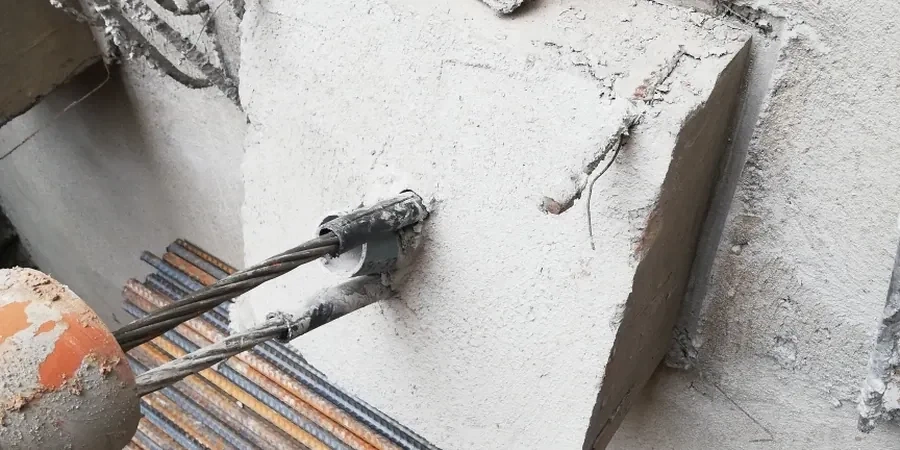
Typical technical challenges in Saskatoon
The most common mistake we see on Saskatoon excavation sites is contractors ordering active anchors and then treating them as passive by skipping the stressing sequence entirely, assuming the wall will mobilize load through deformation. The result is a retaining wall that deflects 50 to 75 millimeters into the excavation before the anchors engage, cracking adjacent sidewalks and utilities. In the Broadway Avenue area, where building offsets are often less than two meters, that amount of movement can trigger a party wall dispute that stops the project for weeks. Another frequent error is underestimating the sulfate content of local till: using ordinary Portland cement grout without sulfate-resistant Type HS cement leads to progressive grout deterioration in as little as five years. For permanent tie-downs under the Saskatchewan Hospital redevelopment zones, we have specified fully encapsulated strand with corrugated HDPE sheathing and factory-greased internals. The NBCC 2020 and CSA A23.3 requirements for anchor prequalification testing are not optional—they must be performed on sacrificial anchors prior to production work, especially in the highly variable Saskatoon Group formations.
Our services
Our work in Saskatoon covers the full lifecycle of ground anchor systems, from initial feasibility through long-term monitoring. The two service categories described below reflect how we typically structure projects in the region.
Active Prestressed Anchor Design and Load Testing
We design active tieback systems for deep basement excavations and retaining walls where movement control is critical. Our scope includes free length and bond length calculation, corrosion protection specification per PTI Class I, and on-site stressing supervision. Every anchor undergoes lift-off testing after lock-off to verify seated load, with follow-up monitoring at 7 and 28 days to assess relaxation losses in the till.
Passive Bar Anchor and Tie-Down Systems
For slope stabilization along the Meewasin Valley trails and uplift resistance for buoyant structures, we specify fully grouted passive anchors using high-yield threadbar. These systems mobilize resistance through ground deformation and are particularly suited to the weathered shale and siltstone bedrock encountered below the till in the river valley. Installation QA includes pull-out testing to 1.5 times design load.
Top questions
What is the difference between an active anchor and a passive anchor?
An active anchor is stressed to a predetermined load immediately after grout curing, typically using a hydraulic jack, and locked off against a bearing plate. This actively compresses the ground and prevents almost all wall movement. A passive anchor is simply grouted into the soil or rock without initial stressing; it only generates resistance when the ground begins to move and load is transferred through the bond zone. In Saskatoon we specify active anchors for cut-and-cover excavations under streets like 8th Street East, and passive anchors for long-term slope stabilization where small deformations are tolerable.
How much does a ground anchor design and installation cost in Saskatoon?
For budgeting purposes, anchor design and installation in Saskatoon typically ranges from CA$1,520 to CA$5,760 per anchor, depending on whether it is a temporary hollow-bar passive anchor or a permanent double-encapsulated active strand anchor with full corrosion protection. The upper end usually involves load testing, lock-off, and long-term monitoring for critical structures. Site access conditions and the presence of cobble layers in the till also influence the final cost.
How deep must anchors be installed to avoid frost heave issues in Saskatoon?
The bond zone of a permanent anchor must start at least 2.1 meters below final grade to stay below the seasonal frost penetration depth typical of Saskatoon winters. We also specify that the top portion of the tendon within the frost zone be debonded with a smooth sheathing so that frost-jacking forces cannot develop along the steel-grout interface. For temporary works with a single winter exposure, this requirement can be relaxed with the understanding that some preload loss may occur.