Saskatoon sits on a complex blanket of glacial till, lacustrine silts, and alluvial deposits from the South Saskatchewan River, much of it susceptible to significant volume change with seasonal moisture swings. A standard Proctor alone isn't enough when you're designing a parking lot on the east side or a heavy-haul road in the north industrial area. The Laboratory CBR test delivers a direct measure of subgrade bearing capacity under controlled moisture and density conditions, which is essential for estimating pavement layer thicknesses that survive freeze-thaw cycles and spring breakup. For projects touching sensitive riverbank silts, we often pair the CBR with a grain-size analysis to spot frost-susceptible fines before the structural section is finalized.
A soaked CBR test on Saskatoon glacial till often yields values between 3% and 8%, meaning the difference between a 6-inch and a 10-inch asphalt section on a commercial lot.
Technical details of the service in Saskatoon
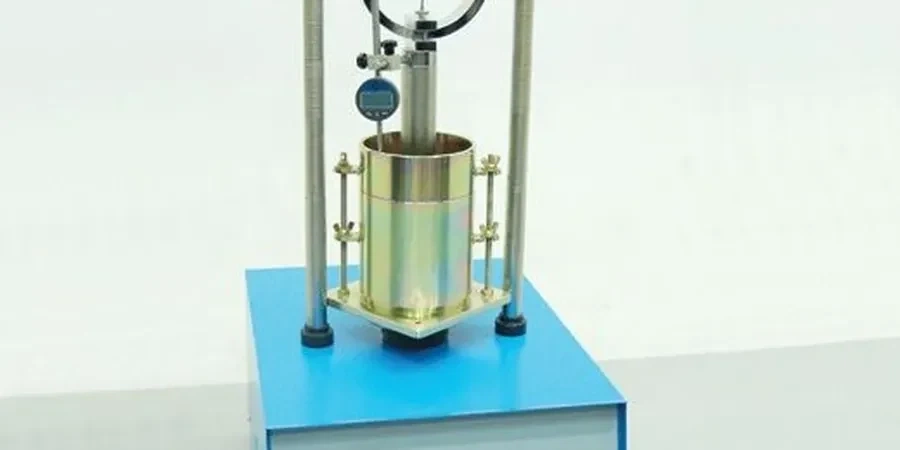
Typical technical challenges in Saskatoon
Saskatoon's expansion since the 1950s pushed development onto low-lying lacustrine plains west of the river, where soft, high-moisture clays underlie many commercial subdivisions. In those areas, skipping a soaked CBR test has led to premature rutting and alligator cracking within three to five years of construction, well before the design life of the pavement. The city's own standard specifications reference CBR-based structural design for arterial roads, and developers who present lab-verified soaked values during the permitting stage typically avoid costly over-excavation change orders later. For parking lots adjacent to the riverbank, where groundwater is within a metre of grade, the swell percentage from the CBR test becomes just as critical as the bearing value, because differential heave can crack curbs and catch basins in a single freeze-thaw season.
Our services
We run the laboratory CBR as part of a broader pavement materials package for Saskatoon projects. The three configurations below cover most field conditions we encounter from the Dundonald industrial area to the Stonebridge commercial developments.
Soaked CBR on Remolded Till
Bulk samples of glacial till compacted at optimum moisture and soaked 96 hours. This is our bread-and-butter test for parking lots and light-duty roads where the subgrade will be recompacted during earthworks.
CBR on Undisturbed Shelby Tubes
For projects where the natural subgrade will remain in place, we extrude Shelby tube samples and test in-situ density and moisture without remolding. Critical for thin overlays and rehabilitation projects on existing roadways.
CBR with Swell and Moisture Suite
Full characterization including swell measurement during soaking, post-soak moisture content, and companion Proctor and Atterberg tests. Used when expansive clays are suspected, common in the lacustrine deposits south of Circle Drive.
Top questions
How much does a laboratory CBR test cost in Saskatoon?
A single-point soaked CBR test on a remolded sample typically runs between CA$190 and CA$250, depending on whether it's part of a larger geotechnical package or a standalone request. If you need multiple points to build a CBR-moisture curve or tests on undisturbed Shelby tube samples, the per-sample cost can be slightly higher because of the extra handling and trimming required. We'll give you a fixed quote before any work starts.
Why do you soak the sample for 96 hours for a Saskatoon pavement design?
The 96-hour soak is part of the ASTM D1883 procedure and it's intended to simulate the worst-case saturated condition the subgrade will background over the life of the pavement. In Saskatoon, spring meltwater and a temporarily elevated water table routinely saturate the upper subgrade for days or weeks. A soaked CBR value is almost always lower than an unsoaked one, sometimes by 40% or more in silty tills, so designing with the soaked value gives a conservative structural section that won't fail during breakup season.
What CBR value should I expect for typical Saskatoon glacial till?
Saskatoon's glacial till, when compacted at optimum moisture and soaked, usually falls in the 3% to 8% CBR range. Higher values, up to 12% or 15%, are possible in dense, sandy till lenses, but we recommend using the lower bound for design unless you have multiple test results confirming a higher average. Lacustrine clays on the west side can drop below 3% soaked, which often triggers a requirement for subgrade improvement or a thicker granular base layer.