The geotechnical contrast between Saskatoon's east-side residential developments along the South Saskatchewan River valley and the industrial lands extending toward the CN rail yards in the west is stark. While the east often contends with thick sequences of glacial lake clays requiring delicate sampling, the west can encounter dense tills that challenge conventional drilling. The cone penetration test bridges this gap, providing a continuous profile of soil behavior that helps engineers understand exactly where these transitions occur. By measuring cone tip resistance and sleeve friction in real time, the data avoids the gaps common with split-spoon recovery. For sites near the river where slope stability becomes a critical design factor, the near-continuous CPT log reveals subtle soft layers that could otherwise go undetected during a standard investigation.
Continuous CPT logs in Saskatoon's glacial clays reveal compressible seams that standard SPT sampling can easily miss, directly influencing settlement predictions.
Technical details of the service in Saskatoon
Typical technical challenges in Saskatoon
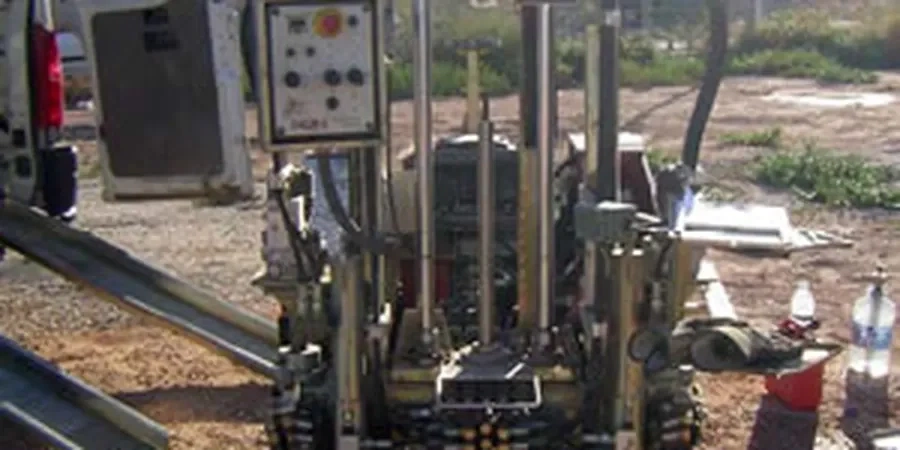
The field operation uses a heavy, truck-mounted rig anchoring itself via screw anchors or deadweight, designed to push a 15 cm² cone into the ground at a steady rate of two centimeters per second. In Saskatoon's west industrial sector, the chief operational risk isn't depth refusal but unexpected subsurface obstructions—buried concrete from demolished grain elevators or large glacial erratics embedded in the till. Hitting one at speed can damage the cone's load cell or shear the push rods. Our protocol requires monitoring the sleeve friction and inclination sensor continuously; a sudden, irregular spike in friction without a corresponding tip resistance increase signals an obstruction rather than a natural dense layer, prompting an immediate stop and rod extraction to prevent equipment loss. For sites adjacent to the river, we also manage artesian pressure risks where the Pleistocene buried valley aquifer underlies the clay cap, requiring careful grouting of the CPT hole upon completion to prevent vertical migration of groundwater between aquifers.
Our services
Our CPT program in Saskatoon is structured around delivering actionable subsurface data, combining advanced cone technology with a pragmatic understanding of local quaternary geology. We deploy a 20-tonne penetration rig capable of handling the dense basal tills that underlie much of the city.
Seismic Cone Penetration Testing (SCPTu)
This test adds a geophone array to the standard piezocone, measuring shear wave velocity downhole every 0.5 meters. The resulting Vs profile is essential for NBCC 2020 site classification, particularly when assessing seismic amplification potential in the soft clays of the Sutherland and Forest Grove areas.
Piezocone Dissipation and Pore Pressure Profiling
In the glaciolacustrine silts that blanket the city's northern fringe, accurate pore pressure measurement is everything. We pause penetration at target depths to record the time required for excess pore pressure to dissipate, giving direct estimates of the coefficient of consolidation—data that dictates staging for preload programs or wick drain design.
Top questions
How does CPT compare to SPT drilling for Saskatoon's clay soils?
Cone penetration testing provides a continuous, digital profile of soil response, whereas the Standard Penetration Test delivers discrete data points every 1.5 meters. In Saskatoon's glaciolacustrine clays, thin silt seams can control consolidation rates; a CPT log captures these seams, while an SPT sampler driven at intervals often misses them entirely. The CPT also eliminates the variable energy corrections and borehole disturbance associated with SPT hammer systems.
What depth can a CPT rig reach in the dense Floral Till?
Penetration refusal in the Floral Till typically occurs between 12 and 20 meters, depending on the till's in-situ density and the presence of cobble-sized clasts. Our 20-tonne push-capacity rig extends investigation depth compared to lighter track-mounted units, but refusal at a boulder-rich horizon is still common. At that point, we often recommend complementing the CPT with a single mud-rotary borehole to sample and log the material beyond refusal depth.
What is the typical cost of a CPT investigation in Saskatoon?
For most residential and light commercial sites around Saskatoon, CPT investigation programs range from CA$260 to CA$290 per meter of penetration, which includes the cone, rig mobilization, data processing, and the engineering report with soil behavior type classification. Total project cost depends on the number of soundings and whether seismic or dissipation modules are required.
Can CPT data be used directly for pile design in Saskatchewan?
Yes, direct CPT-based methods are widely accepted for estimating axial pile capacity in the soils found around Saskatoon. The LCPC (French Road and Bridge Laboratories) method, which uses cone tip resistance and sleeve friction to calculate unit skin friction and end bearing, is particularly well-suited to the overconsolidated tills and dense sands of the region. We validate these estimates against load test databases and local background with driven steel and continuous flight auger piles.