In Saskatoon, the presence of the upper glacial till—often overconsolidated and fissured—creates a distinct set of challenges for deep excavation. A cut of 6 or 8 meters near the South Saskatchewan River can behave very differently from one in the Sutherland area. We've seen contractors surprised by stress relief fractures opening up overnight in the Battleford Till. The key isn't just retention; it's understanding how the Floral Formation till relaxes when unloaded. We integrate in-situ data from spt-drilling to calibrate our strength models because the blow counts don't always tell the full story in these stiff, clay-rich deposits. The design must also account for the seasonal groundwater fluctuation that can saturate the upper weathered zone, turning a dry-looking cut into a stability problem within hours.
The stiff till in Saskatoon demands a design that respects its peak strength but plans for its post-peak relaxation.
Technical details of the service in Saskatoon
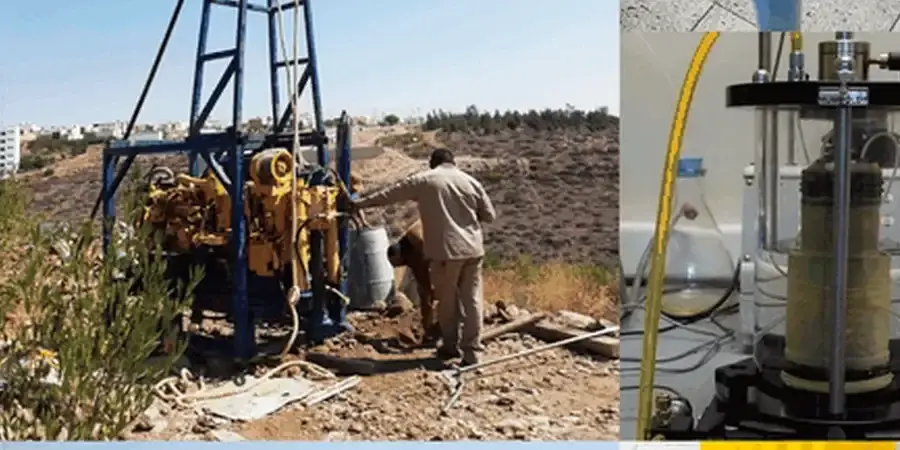
Typical technical challenges in Saskatoon
A project on 2nd Avenue required an 11-meter excavation next to a masonry building from the 1920s. The risk wasn't base heave—the till is strong enough for that—but the lateral movement of the shoring wall. We predicted 18 mm of deflection using a hardening soil model in PLAXIS. The actual movement, tracked by inclinometers, hit 15 mm. That 3 mm margin saved the adjacent structure from cracking. The biggest risk in Saskatoon deep excavations is misjudging the pre-existing fractures in the till. A block failure along a slickensided plane is possible if the excavation is aligned unfavorably. This is why we insist on a thorough geotechnical baseline report before finalizing the shoring drawings.
Our services
Our scope of work for deep excavations in Saskatoon is structured to cover every phase of the design.
Shoring and Retention Design
We develop construction-ready drawings for soldier pile walls, secant pile walls, and tieback anchor systems. Our designs are stamped by a professional engineer licensed in Saskatchewan, and we include detailed movement predictions to satisfy adjacent property protection requirements.
Excavation Base Stability Analysis
We check for basal heave and piping in excavations that encounter sand and silt lenses within the till. The analysis uses the bearing capacity factors from the Canadian Foundation Engineering Manual, adjusted for the anisotropic strength of the local till.
Top questions
What is the typical cost range for a deep excavation design in Saskatoon?
For a standard project, the engineering design fee ranges from CA$2,990 for a simple single-family basement shoring plan to CA$11,430 for a complex multi-level excavation with tieback anchors and instrumentation monitoring. The final cost depends on the depth of the cut, proximity to adjacent structures, and the complexity of the groundwater control system required.
How deep can you excavate in Saskatoon's glacial till before you need tieback anchors?
Typically, a cantilever soldier pile wall can work up to about 4 to 5 meters in the stiff Battleford Till. Beyond that, we need lateral support. For cuts between 5 and 8 meters, a single level of struts or tiebacks is usually sufficient. For excavations deeper than 8 meters, we often design a system with two or more levels of ground anchors to limit wall deflections and bending moments.
How do you handle groundwater during deep excavations in Saskatoon?
The till itself has very low permeability, but sand and silt lenses can carry significant water. We specify a combination of perimeter sump pumps for general seepage and wellpoint systems if we hit a continuous sand layer. The design includes a filter fabric and crushed rock drainage layer behind the lagging to prevent fines from migrating and causing settlement outside the excavation.
What is the review process with the City of Saskatoon for a shoring design?
The city requires a stamped engineer's drawing for any excavation deeper than 1.2 meters that is adjacent to a public right-of-way. Our submission package includes the structural calculations, a geotechnical report, and a pre-construction condition survey of the adjacent properties. The review timeline is typically two to three weeks for a standard commercial project.