Saskatoon sits on a foundation of complex glacial stratigraphy—roughly 80 m of tills, interglacial silts, and sands deposited during the Pleistocene, overlying Cretaceous shale. This legacy means that compaction control isn't just a checkmark; it's the single most reliable indicator that your fill and subgrade will behave as designed through freeze-thaw cycles that swing from -40 °C to +35 °C. A field density test using the sand cone method (ASTM D1556) provides direct measurement of in-place density, and when paired with a laboratory Proctor test to establish the maximum dry density reference, you get a true compaction percentage. In Saskatoon's east-side residential subdivisions or north-end industrial pads, where native silty tills can lose strength if under-compacted, we run sand cone tests at depths and frequencies that match the NBCC and the city's geotechnical submission requirements.
Compaction acceptance in Saskatoon's glacial tills demands a field density test that accounts for material variability—ASTM D1556 paired with on-the-spot Proctor correlation delivers exactly that.
Technical details of the service in Saskatoon
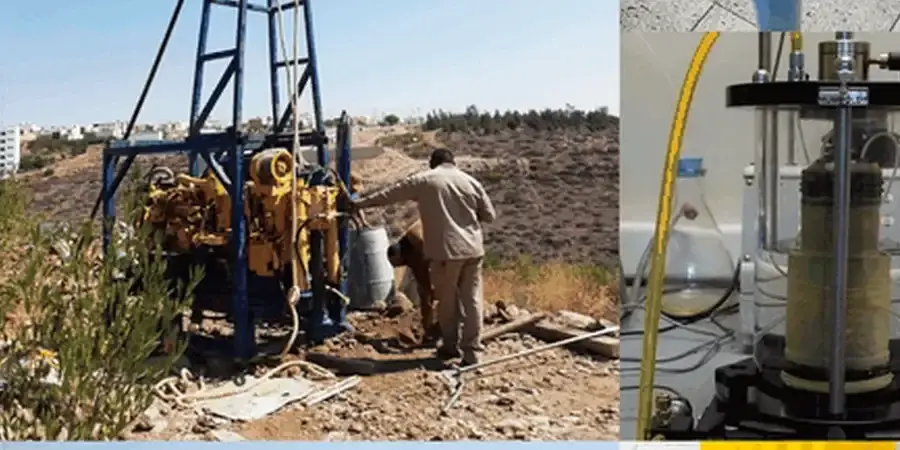
Procedure video
Typical technical challenges in Saskatoon
On a 4-storey mixed-use building along 8th Street East, the structural fill beneath the parkade slab had been placed in late October, just before freeze-up. Density tests run the following spring revealed zones at only 91% of Standard Proctor maximum dry density—well below the 98% specified. The differential heave that winter had opened micro-fissures in the till, and spring meltwater infiltration softened the matrix further. The remediation required removing 600 mm of fill, scarifying the subgrade, and recompacting in thin lifts with moisture control, followed by full sand cone retesting. That episode cost the developer six weeks and roughly CA$85,000 in change orders. In Saskatoon's climate, where frost can penetrate 1.8 m or more in an open excavation, the window for compaction work is tight—typically May through October—and every lift must be verified with a field density test before cover or paving. Skipping this step on a frost-susceptible till is not a risk; it's a guaranteed future failure.
Our services
Our compaction control solutions in Saskatoon cover the full chain from laboratory reference testing to field verification and reporting. Each sand cone test includes a signed field ticket with the compaction curve overlay, so the superintendent has actionable data before the end of the shift.
Field Density by Sand Cone (ASTM D1556)
Direct measurement of in-place wet and dry density on fill, backfill, and subgrade. Includes calibrated Ottawa sand, field moisture determination, and real-time calculation of percent compaction against the applicable Proctor curve. Reporting meets City of Saskatoon and consulting engineer requirements.
Proctor Testing and Compaction Curve Development
Standard and Modified Proctor tests (ASTM D698/D1557) run on representative samples of site borrow material. The compaction curve establishes the maximum dry density and optimum moisture content that the sand cone field result is compared against. We run multi-point curves when material variability across the site is expected.
Top questions
How much does a sand cone field density test cost in Saskatoon?
A single field density test using the sand cone method typically runs between CA$140 and CA$220 per point, depending on site access, number of tests per mobilization, and whether immediate moisture content determination is required. Projects with 10 or more points on the same day usually fall at the lower end of that range.
How does the sand cone method compare to a nuclear density gauge on Saskatoon's tills?
The sand cone method is a direct volumetric measurement—you excavate, weigh the soil, and measure the hole volume with calibrated sand. On Saskatoon's glacial tills, which can contain scattered pebbles and cobbles, nuclear gauges sometimes give erratic readings because the source-detector geometry assumes a homogeneous matrix. Sand cone avoids that error, and it doesn't require a radiation license, which simplifies site logistics. The trade-off is speed: a sand cone test takes about 20–30 minutes versus under 5 minutes for a nuclear gauge.
What compaction standard does the City of Saskatoon require for residential subdivisions?
Most residential subdivision agreements in Saskatoon reference 98% of Standard Proctor maximum dry density (ASTM D698) for structural fill beneath footings and floor slabs, and 95% for general landscape fill. The exact specification is project-dependent and should be confirmed in the geotechnical report, but these are the typical acceptance thresholds we see on sites in Rosewood, Evergreen, and Brighton.