Too many earthworks contractors in Saskatoon run the rollers and hope for the best. Then the fill settles. The slab cracks. And the call comes in after occupancy. What went wrong? The fines content. The South Saskatchewan River carved deep channels here, leaving stratified sands and silts across neighborhoods like Nutana and River Heights. Standard compaction won't reach 10-meter depths. When we design a vibrocompaction program, we start with the grain-size curve from a grain-size analysis because just 12% passing the #200 sieve changes everything. If the material is too silty, vibroflotation won't couple—so we validate parameters with a CPT test before mobilizing the rig.
Vibrocompaction works when the fines content is below 15%. Above that, you are just vibrating silt—design shifts to stone columns.
Technical details of the service in Saskatoon
Key design inputs we always specify: probe diameter (usually 16 or 19 inches), water pressure at the jets (100 to 150 psi for the local sand), and backfill consumption per meter. The City of Saskatoon's building permit process will ask for post-treatment verification. We typically prescribe SPT or CPT testing on a 7-meter grid after treatment, cross-referenced against pre-treatment baselines. One thing we see often: contractors trying to save money by skipping the pre-treatment survey. You need that baseline to prove improvement to the geotechnical engineer of record.
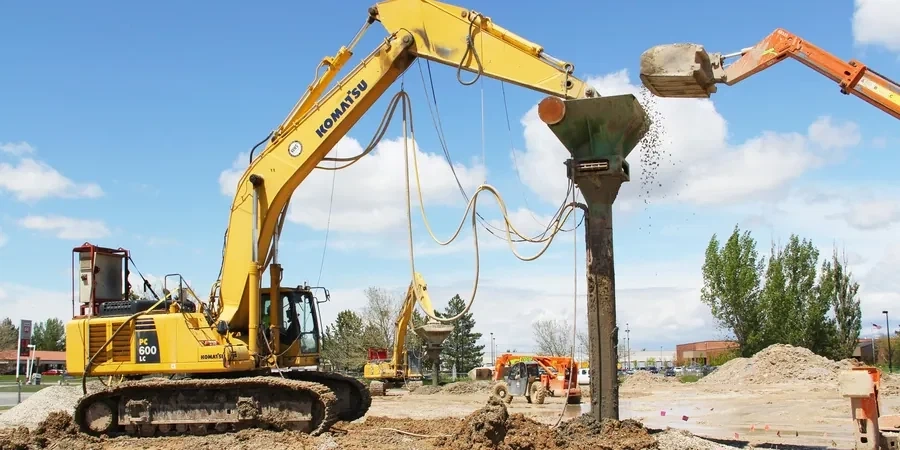
Typical technical challenges in Saskatoon
NBCC 2015 and CSA A23.3 demand that foundations bear on soil with demonstrated bearing capacity—not assumed. In Saskatoon, the risk isn't just settlement; it's differential settlement across the transition from riverbank sands to glacial till. We've seen 40 mm of differential movement in less than 15 meters of horizontal distance near the Meewasin Valley. A vibrocompaction design that treats the site as uniform will miss this transition. The probe must penetrate through the loose alluvium and into the competent till to avoid a soft toe condition. Liquefaction potential under seismic loading also enters the picture—Saskatoon sits in a moderate seismic zone under NBCC, and loose saturated sands below the water table at 5 to 7 meters depth require evaluation. Our designs reference Youd-Idriss (2001) procedures for liquefaction resistance, correlating post-treatment CPT tip resistance to the required factor of safety.
Our services
Before a single probe enters the ground, the design must be locked down with site-specific data. These two service packages cover what we deliver for Saskatoon projects:
Vibrocompaction Trial Program
We design and supervise a test section—typically 4 to 6 probes on a representative grid. Electrical demand, hold time, and backfill take are recorded every 0.5 meters. The trial validates that the target relative density is achievable with the available rig power before full production begins.
Performance Specification Package
A sealed design package for the contractor: grid layout with probe locations, penetration depth per zone, acceptance criteria (minimum CPT tip resistance or SPT N-value), water pressure limits, and backfill gradation spec. Includes a monitoring plan for post-treatment verification and a report for City of Saskatoon permit submission.
Top questions
Is vibrocompaction effective in Saskatoon's silty sands?
It depends on the fines content. In clean to slightly silty sands—common on the east side and in older river terraces—vibrocompaction works very well. Once silt exceeds 15 to 18 percent, the pore pressure cannot dissipate fast enough during vibration. In those conditions we recommend evaluating stone columns instead. A grain-size analysis from a split-spoon sample is the first decision gate.
What depth can vibrocompaction treat here?
In Saskatoon's geology, we typically treat depths from 3 meters down to about 20 meters. The loose sand lenses sit above the glacial till, which is naturally dense. We design the probe to penetrate the full loose column and seat into the till by at least 1 meter to eliminate a soft bottom boundary. Probe depth is limited by the rig's pull-down capacity and the crane's reach, not by the soil.
How much does a vibrocompaction design cost for a typical commercial lot?
For a standalone design package covering a commercial lot up to 2,000 square meters—including site review, trial program supervision, performance spec, and post-treatment verification plan—the fee ranges from CA$2,180 to CA$6,920 depending on subsurface complexity and the number of treatment zones. A site with uniform sand is at the lower end; a site crossing multiple geological units with variable groundwater is at the upper end.
How do you verify that the compaction actually worked?
We specify pre-treatment and post-treatment CPT soundings on a staggered grid, typically every 7 meters. The acceptance criterion is a minimum tip resistance correlated to the target relative density—usually 70 to 85 percent. We also check that the improvement ratio (post-treatment tip resistance divided by pre-treatment) exceeds 1.5 across 90 percent of the treated depth. SPT with energy-calibrated hammers is acceptable when cobbles prevent CPT pushing.