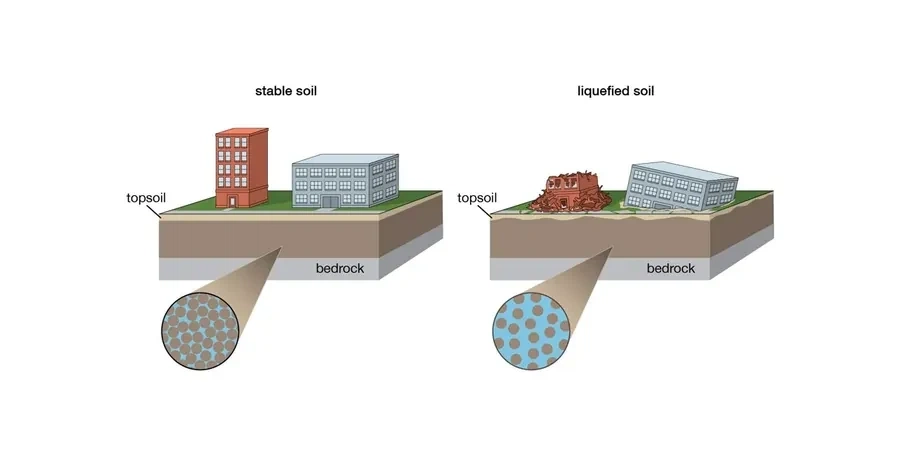
The subsurface conditions in Saskatoon shift dramatically between the dense glacial till east of the river and the loose alluvial sands deposited by the South Saskatchewan River in neighborhoods like River Heights and Nutana. While the heavy clays of the Sutherland area offer decent bearing, the saturated fine sands near the riverbanks present a different challenge entirely: a real potential for strength loss during seismic shaking. A rigorous soil liquefaction analysis becomes essential whenever a project sits on these post-glacial fluvial deposits, because the consequences of getting it wrong range from differential settlement to complete bearing failure. Our laboratory processes undisturbed Shelby tube samples and SPT data to quantify this risk, applying cyclic stress ratio calculations adapted to Saskatoon's specific seismicity as defined in the NBCC 2020. For deeper profiles where sampling is difficult, we often pair the assessment with in-situ CPT testing to obtain continuous pore pressure and tip resistance curves, which supply a high-resolution signature of the soil's contractive behavior.
A clean sand with less than 15% fines and an (N1)60 below 15 in Saskatoon's riverbank zones will almost certainly require Improvement once the seismic demand exceeds the cyclic resistance ratio.
Technical details of the service in Saskatoon
Procedure video
Typical technical challenges in Saskatoon
The NBCC 2020 assigns Saskatoon a seismic hazard value that, while moderate on paper, demands a specific site-class amplification according to Table 4.1.8.4. The risk isn't in the peak acceleration itself — it is in the prolonged duration of shaking that can develop on the soft, normally consolidated clays of the glacial lake basin. When a thin sand layer is trapped beneath a clay crust in areas like the North Industrial district, a seismic event can generate excess pore pressure that cannot dissipate quickly enough, leading to a 'crust' failure where heavy equipment or shallow footings punch through without warning. Ignoring this secondary hazard in a soil liquefaction analysis leaves contractors exposed to sudden grade-beam rupture during the construction phase, long before the operational life of the building begins. The standard of care in Saskatchewan geotechnical practice now explicitly requires a liquefaction screening for any structure classified as Importance Category 3 or higher, and our reports supply the signed engineering documentation to satisfy that regulatory requirement for the local building permit office.
Our services
Our laboratory in Saskatoon delivers a complete workflow for liquefaction assessment, starting from the drilling program design through to the final settlement analysis. The two core service packages address the most common scenarios we encounter in central Saskatchewan.
SPT-Based Liquefaction Triggering Assessment
We mobilize a CME-75 drill rig to perform standard penetration tests with energy-calibrated hammers, recording blow count every 1.5 meters. Samples are sealed in the field to preserve moisture content, and we run a full Atterberg limits and sieve analysis on every split spoon. The report delivers a factor of safety at each sample depth, an LPI contour, and a clear yes/no on whether Improvement is triggered under the NBCC 2020 design earthquake.
Cyclic Laboratory Testing for Site-Specific CRR
For high-importance structures where SPT correlations are considered too conservative, we reconstitute undisturbed specimens to field density and run stress-controlled cyclic triaxial tests under an effective confining pressure matching the in-situ overburden. The number of cycles to 5% double-amplitude axial strain defines the CRR curve directly, without reliance on empirical regression, giving the structural engineer a defensible basis for reducing the foundation improvement scope.
Top questions
What triggers the requirement for a soil liquefaction analysis on a Saskatoon building permit?
Under NBCC 2020, any structure assigned to Importance Category 3 (schools, community centers, large commercial) or 4 (hospitals, emergency response facilities) requires a seismic site-specific investigation that includes liquefaction screening if the water table is shallower than 4 meters and the site contains sands with SPT blow counts (N1)60 below 30. The City of Saskatoon building department will normally flag this as a condition of permit issuance for projects within 500 meters of the South Saskatchewan River mapped floodplain.
How much does a liquefaction study typically cost for a residential lot in Saskatoon?
For a standard single-family lot with two 15-meter boreholes and the full laboratory index testing plus SPT-based liquefaction triggering report, the fee generally ranges from CA$3.670 to CA$6.300. The final amount depends on access conditions, whether a track-mounted or truck-mounted rig is needed, and the number of cyclic triaxial tests if the empirical approach yields borderline factors of safety that require refinement.
Can Saskatoon's glacial till actually liquefy, or is it just the river sands?
True glacial till — the unsorted, overconsolidated mixture of clay, silt, sand, and cobbles found across most of Saskatoon — is generally non-liquefiable because of its high density and plasticity. The hazard concentrates in interbedded lenses of outwash sand and silt deposited by glacial meltwater, and in the recent alluvium of the South Saskatchewan River. Our lab always splits the sample and runs a quick plasticity test first: if the plasticity index exceeds 12, the soil is excluded from the liquefiable category per the modified Chinese criteria we apply as a screening step.
What Improvement methods does the analysis recommend if the factor of safety is too low?
When the calculated factor of safety against liquefaction falls below 1.1 for the design earthquake, the report identifies the depth interval requiring treatment and evaluates compatible methods. In Saskatoon's urban lots with limited overhead clearance, we typically evaluate stone columns for densification or compaction grouting for silty sands. For larger greenfield sites, we compare the cost of vibrocompaction against a deep foundation solution that bypasses the liquefiable layer entirely, such as driven steel H-piles socketed into the competent till.