We recently reviewed a project on Spadina Crescent where a developer planned a four-level underground parkade. The excavation hit saturated glacial till at just three meters, and the original cantilever wall design was no longer viable. The groundwater pressure and the lateral squeeze from the stiff clay demanded a complete rethink of the earth retention strategy. This is a scenario we encounter repeatedly across Saskatoon, especially near the South Saskatchewan River where the valley walls add topographic complexity. In our background, retaining wall design here is never a straightforward copy of a standard detail. The interaction between the surficial lacustrine clays and the underlying till requires a design that accounts for both short-term construction loading and the long-term swelling pressures that develop as the soil moisture regime re-equilibrates after backfilling. We rely on site-specific parameters from our in-situ permeability testing to model the drainage conditions behind the wall, which directly influences the design earth pressure diagram we adopt for the structural analysis.
Designing a retaining wall in Saskatoon is fundamentally a moisture-control problem—manage the water and you manage the lateral earth pressure.
Technical details of the service in Saskatoon
Typical technical challenges in Saskatoon
Saskatoon's urban expansion from the riverside CN rail yards outward has created a patchwork of fill materials over the native clay plain. Much of the city's east side development sits on deposits that were reworked during the mid-20th century, and the fill often contains brick fragments, wood debris, and variable amounts of organic silt. We have pulled auger samples in the Nutana area that showed a compressible layer right where the footing of a proposed gravity wall was meant to bear. The risk of differential settlement is high if the wall is founded partly on dense till and partly on this fill. Another risk we see repeatedly is poor compaction of the backfill zone. In a climate with 30-degree temperature swings in spring, a poorly drained and loosely placed backfill will generate pore pressures that exceed the design assumptions. We address this by specifying a free-draining granular wedge and confirming the compaction with field density testing, ensuring the wall performance matches the design intent over the full service life.
Our services
Our retaining wall design workflow in Saskatoon moves from a clear geotechnical model to a constructible structural solution, with every step calibrated to local soil behavior and regulatory requirements.
Geotechnical Site Characterization for Retaining Walls
We drill and sample the specific wall alignment to define the stratigraphy, measure the groundwater level, and obtain high-quality specimens for advanced laboratory testing. This includes consolidation and triaxial tests to determine the drained and undrained strength parameters that feed into the lateral earth pressure calculations.
Structural Analysis and Reinforcement Detailing
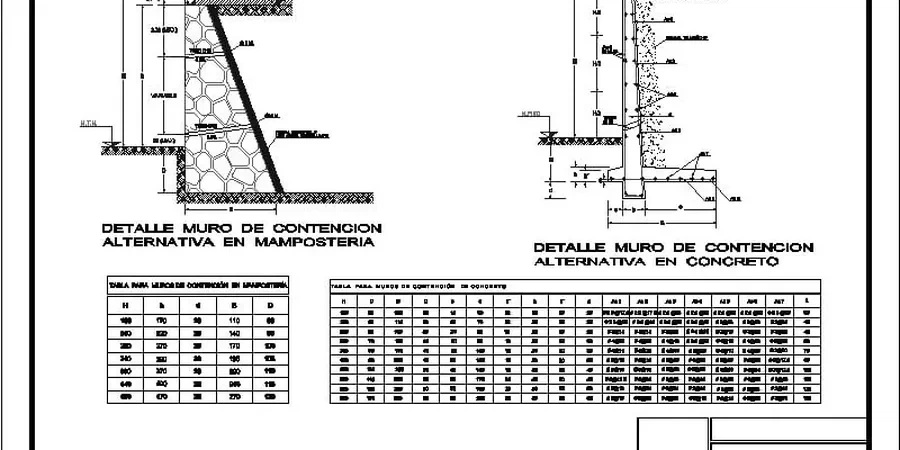
We perform the complete structural design of cantilever, counterfort, and anchored walls in accordance with CSA A23.3. Our deliverables include detailed reinforcement schedules, development lengths, and crack-control checks, with a focus on the sulfate-resistant concrete mixes required for the local till environment.
Global Stability and Drainage Design
For walls exceeding 2 meters in height or located on sloping ground, we conduct limit-equilibrium slope stability analyses that include the wall as a structural element. We also design the subsurface drainage system—weep holes, chimney drains, and collector pipes—to prevent hydrostatic pressure buildup behind the wall stem.
Top questions
What is the typical cost range for a retaining wall design in Saskatoon?
For a complete geotechnical investigation and structural design package, the fee typically ranges from CA$1,400 for a straightforward residential garden wall to CA$5,780 for a complex commercial retaining structure with tiered walls, anchors, and comprehensive drainage design. The final cost depends on the wall height, proximity to property lines, and the number of boreholes required to characterize the site stratigraphy.
How does the expansive clay in Saskatoon affect the design of a retaining wall?
The high-plasticity clays of the Battleford Formation can swell significantly with moisture changes. We design the wall to accommodate the lateral swelling pressure, which can be as high as the passive earth pressure in some cases. We also specify a granular backfill zone and a geotextile filter to prevent the clay from migrating into the drainage system, and we often recommend a flexible wall system or an expanded polystyrene (EPS) compressible layer behind rigid walls to absorb the volume change.
Do I need a building permit for a retaining wall in Saskatoon?
Yes, the City of Saskatoon requires a building permit for retaining walls over 1.2 meters in height, measured from the bottom of the footing to the top of the wall. Walls supporting a surcharge, such as a driveway or a building, require a permit regardless of height. The permit application must be accompanied by sealed engineering drawings and a geotechnical report that confirms the soil bearing capacity and the global stability of the site.
What drainage measures are essential for a retaining wall in this climate?
Given Saskatoon's freeze-thaw cycles and the fine-grained nature of the native soils, we consider a solid drainage system as mandatory. This includes a continuous perforated pipe at the base of the wall, a chimney drain of clean, free-draining gravel, and a filter fabric to separate the gravel from the surrounding clay. We also detail the weep holes to discharge at a safe distance from the wall toe, preventing erosion and ice lensing at the base.