In Saskatoon, you learn quickly that the Meewasin Valley isn't just a pretty view—it's a working river that has spent millennia depositing soft, high-plasticity clays and loose alluvial silts right where half the city's infrastructure wants to go. The South Saskatchewan River cuts through town, and with it comes a legacy of lacustrine Lake Agassiz clays that can lose significant shear strength when disturbed. We've seen preliminary tunnel designs that looked fine on paper until a basic triaxial test revealed strain-softening behavior nobody budgeted for. That's why our geotechnical analysis for soft soil tunnels starts with high-quality Shelby tube sampling and extends through undrained shear strength profiling, consolidation testing, and time-dependent deformation modeling. For projects near the riverbanks where granular interbeds create mixed-face conditions, we combine this with CPT testing to map the transition zones without gaps. And when the alignment runs deeper into the glacial till, a seismic refraction survey helps distinguish weathered till from intact lodgment till before the TBM ever arrives on site.
Undrained shear strength anisotropy in Saskatoon's Lake Agassiz clays can vary by a factor of two between compression and extension—if your tunnel lining design ignores this, you're under-engineering the springline.
Technical details of the service in Saskatoon
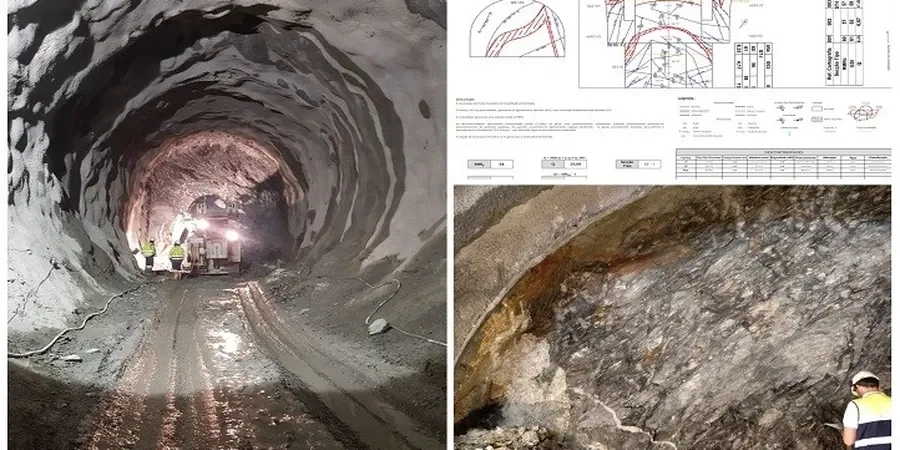
Typical technical challenges in Saskatoon
Saskatoon's subsurface carries a particular risk that shows up in the borehole logs as a sharp contact between the stiff glacial till and the overlying soft clay: the till surface is rarely flat. It undulates, sometimes by three or four meters within a single city block, which means a tunnel designed for a uniform clay face can suddenly find its crown in till and its invert in soft clay, or vice versa. That kind of mixed-face condition generates asymmetric loading on the liner and accelerates cutter wear on an EPB machine. The groundwater table sits high across much of the city—typically 1.5 to 3 meters below grade—and where the till is fractured, it transmits water from the riverbank aquifer into the excavation zone. We've measured pore pressures in sand lenses that exceed hydrostatic by 15 to 20 percent, implying artesian influence that standard drained parameters won't capture. A liquefaction assessment becomes relevant not for the clay itself, but for those saturated granular interbeds that can fluidize under seismic loading—Saskatoon sits in NBCC seismic hazard zone 2, and the 2015 Seismic Hazard Model for Western Canada gives a 2%-in-50-year PGA of 0.08g to 0.12g depending on site class. It's modest, but for a tunnel under the river, even modest shaking in loose saturated sand can cause differential settlement that compromises the segment gaskets. Time-dependent settlement from consolidation is the other big one: a tunnel in normally consolidated clay can settle for years after construction, and if the liner isn't designed with enough flexibility at the joints, you end up with cracking and leakage long after the TBM has moved on.
Our services
For soft ground tunnel projects in Saskatoon, we supply a focused set of analytical solutions that bridge the gap between site investigation data and practical design parameters. Each deliverable is calibrated to the specific clay units, till stratigraphy, and groundwater conditions encountered in the region.
Tunnel Face Stability and Ground Reaction Analysis
We model short-term undrained stability using limit equilibrium and finite element methods, outputting support pressures, stand-up times, and ground reaction curves for each chainage. Inputs come directly from CIU triaxial tests and consolidation data on Shelby tube samples taken at tunnel depth. For EPB tunneling, we calibrate face pressure ranges against the measured undrained shear strength profile and account for the sensitivity of the Lake Agassiz clay to remolding.
Settlement Trough Prediction and Building Damage Assessment
Using empirical methods (Peck, O'Reilly-New) validated with local case histories and supplemented by 2D/3D FE models, we estimate surface settlement troughs, angular distortion at adjacent structures, and time-dependent consolidation settlement. We overlay results on city infrastructure maps to identify sensitive receptors—heritage buildings downtown, riverbank slope infrastructure, and buried utilities—and supply damage category assessments per Burland and Boscardin-Cording criteria.
Top questions
What type of laboratory testing is most important for tunneling in Saskatoon's soft clays?
The most critical tests are CIU triaxial compression and extension tests (ASTM D4767) on undisturbed samples, paired with one-dimensional consolidation tests (CSA + ASTM D2435). Saskatoon's Lake Agassiz clays exhibit significant undrained strength anisotropy, so measuring Su in both compression and extension modes is essential for tunnel lining design. Consolidation testing with pore pressure measurement provides the cv and Cc values needed for settlement time-history predictions, which matter because these clays can settle for years after construction.
How much does a geotechnical analysis for a soft soil tunnel in Saskatoon typically cost?
For a tunnel project in Saskatoon, the geotechnical analysis scope typically ranges between CA$6,450 and CA$21,680 depending on the number of boreholes, the depth of the tunnel alignment, the quantity of triaxial and consolidation tests required, and whether advanced numerical modeling (FE 2D/3D) is included. A straightforward analysis with a limited lab program sits at the lower end, while a full program with multiple sampling depths, CIU/CAU testing, consolidation suites, and settlement modeling reaches the upper range.
How do you handle mixed-face conditions where the tunnel crown is in till and the invert is in soft clay?
Mixed-face conditions are common in Saskatoon due to the undulating till surface. We map the contact using CPT soundings and seismic refraction surveys, then run separate triaxial programs on both materials. The analysis evaluates asymmetric loading on the liner, potential for face instability at the interface, and differential stiffness that can concentrate bending moments. We typically recommend a segmented liner with articulation at the joints and a face support pressure that splits the difference between the two materials' requirements, monitored closely during advance.